


Baby bonding exercises – Mums and Bubs
/Here is a exercise routine you can do to increase your strength and simultaneously bond with your baby!
In the first two years of your baby’s life, the most important thing you can give to them to help them turn in to happy successful adults is LOVE (Biddulph, 2011).
Massage, cuddles, talking and dancing, story time, play time shared with your baby are all opportunities for baby bonding. Looking directly into their eyes as you talk lovingly and singing to your baby is invaluable. They know if you are being distracted with watching the TV and not giving them 100% of your time.
I went to this talk on raising girls by Psychologist Steve Biddulph from the book Raising Girls (2011), and he said if the father can give undivided attention to the girl, the girl will grow to know that if her Dad dedicated that time to her that she must be worthwhile and set higher standards for the people she ends up dating, not settling for people that don’t treat her right. I have not heard his research on boys but I am sure it would be of a very similar vein. https://www.goodreads.com/author/show/119122.Steve_Biddulph
See my blogs on Baby Massage, and I finally got my role on Play School for more on bonding ideas.
So in addition to all the bonding suggestions above you can multitask and do some exercise whilst bonding with your baby. You may have heard of Mums and Bubs classes which I have run. They are great, but as you understand, it is really hard to get out of the house and make a class on time. At the start at least you want to work around your baby and their unpredictable routines. Later when you have got some order back in your life the classes can be a nice way to socialise with other Mums.
In the early stages (first 6-12 weeks, sometimes longer if it is not your first baby) before your linea alba (connective tissue that joins the two sides of your superficial stomach muscles together) has reconnected (see future blog on Linea Alba separation and Exercises), the exercises in the future blog Exercise Routine while Settling your Baby are completely safe to do.
After your physiotherapist has assessed your stomach to see that it has rejoined and that your pelvis is stable you may commence these exercises below.
Squats and lunges
These put a lot of pressure on the pelvis so you have to make sure it is stable. If there is any pain doing these exercises see your physiotherapist to get it assessed. You should first do these exercises not holding your baby (they can lie/ sit on the floor in front of you) but as you get stronger hold your baby close to your chest with your core on. We do so much squatting picking our baby’s off the floor we need to develop good leg strength so that we are not tempted to lift with our backs and do a back injury. Try and do 3 sets of 10 of squats and lunges. Start shallow and get lower as you get stronger. There is no need to bend your knees more than 90 degrees when squatting, keep your back straight, core on and get lower to the ground (when doing it functionally to pick up your baby/ toys etc) by bending at your hips.
Bicep curls
Stand with your feet hip width apart holding your baby to your chest with your core on. Then straighten your elbows lowering your baby then bend your arms and baby to your chest again. As you get stronger straighten your arms further. When you can get full extension you can increase the number of reps. Aim for 10 reps x 3. This is also an extremely functional exercise.
Push ups
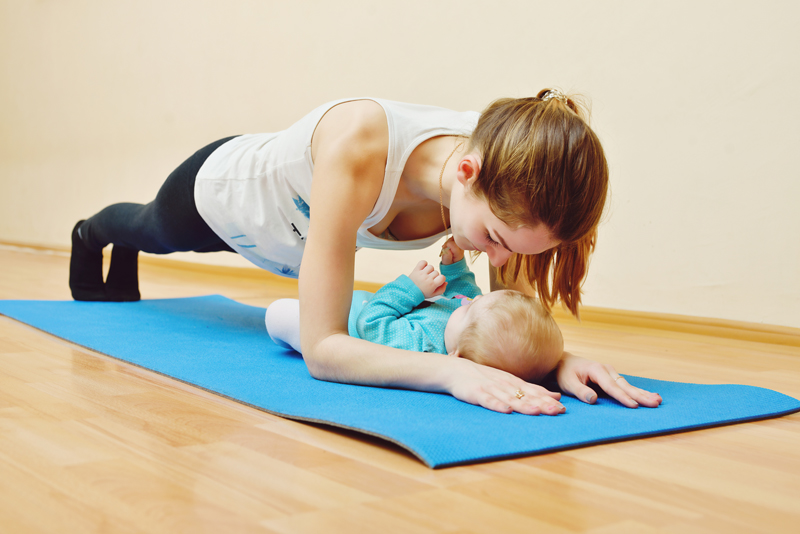
Great for the fudupitas (spelling?!) – the triceps. Lie you baby on the floor- vary their position for their strengthening exercises but for this exercise best bonding is done with them lying on your back and you kneeling over the top of them in push up position. Start with your knees on the floor and hands either side of your baby and then slowly bend your elbows keeping your body in a straight line (ie keeping your bottom low). As you get stronger bend your arms further aiming to be able to kiss your baby. Depending on your previous strength this may take a while! This puts pressure on your core so again if your linea alba is still separated this could cause more separation. Aim for 10 x 3 reps.
Bench press your baby
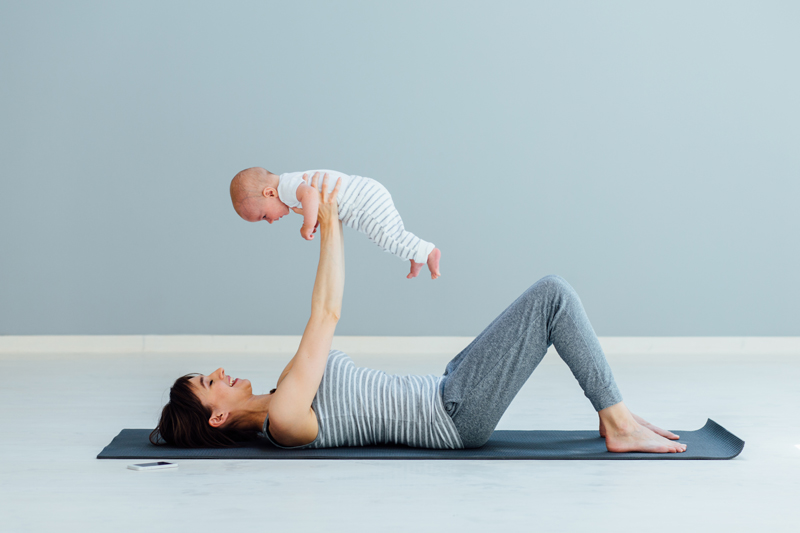
When your baby has enough head control (about 2-3 months) and they have lost their startle reflex (about the same time) you can lie on your back with knees bent, core on and hold your baby around their chest and straighten your elbows. Misaki loves it! This might not work for a wriggly baby though!
“I have lost count the times people get back pain from doing planks...”
Planks
Now this is a very hard core exercise and I have lost count how many times I have seen patients for back pain and I hear they have been told by their personal trainer/ gym instructors to do planks when their core is not strong enough and this has contributed to their back pain, not helped it!
They are definitely not to be done until the linea alba has regained its strength. It is also important to self monitor how your back muscles feel. If you feel they are getting tight or sore when you do this exercise it means that your core is not strong enough to do the exercise so STOP.
This exercise can be modified for you current level of fitness. Use the back tension/ pain as a way to self monitor how far you can go. Start by kneeling in all fours over your baby. Tilt your pelvis so you are lifting up your stomach and flattening your back (Switching on the Core blog to be published soon). Keep breathing and hold for 10 seconds. If there is no back tension walk your hands 5 cm only. Then retry the above technique.
If you feel your back get tight do the next rep back 5 cm. Over time slowly progress your hands out further and further until you are resting on your forearms and knees. You can then progress to the full plank with knees off the ground. This could take MONTHS to obtain so please don’t rush so that you end up coming to see us for back pain you were trying to prevent. This exercise, as it is a big core work out should actually relieve back tension and pain not increase it.
“If you are getting tension in the back of your neck the exercise is too much so STOP...”
Side plank
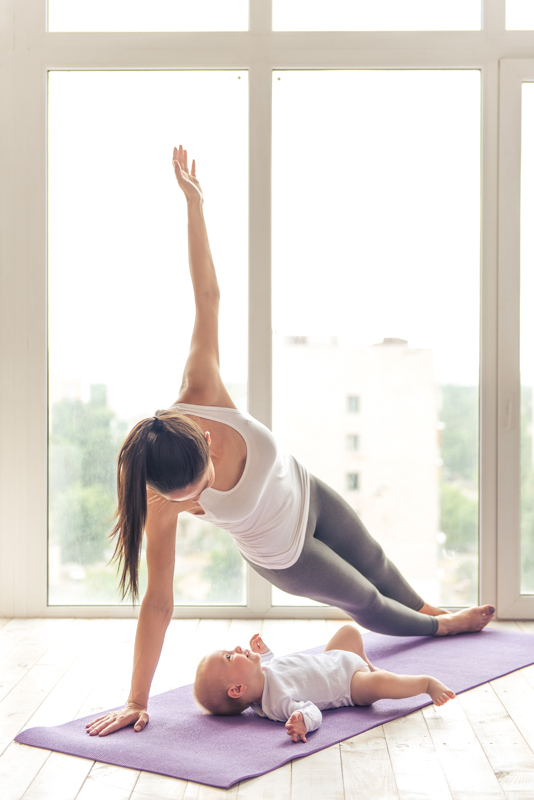
This is also great for the core and recruits more of the obliques part of the core. Side lye next to your baby who can side lye facing you. Lift yourself up on to your forearm and knees. If you are getting tension in the back of your neck the exercise is too much for you so STOP. This exercise can be further progressed but best guided by physiotherapy assistance.
Bridge
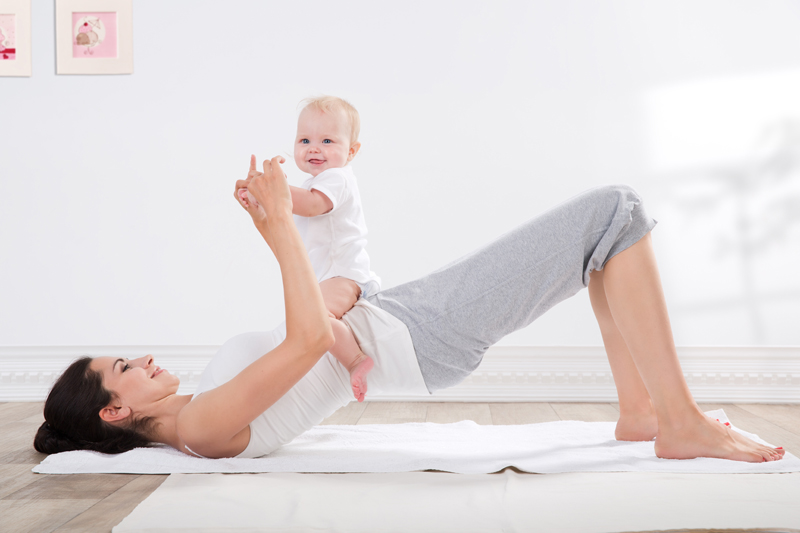
Lye on your back with your knees bent and your baby resting on your lap. You can then tilt your pelvis to switch on the core and then lift up your bottom so that your legs are in line with your torso. As mentioned in future blog, Exercise Routine while Settling your Baby, you need to switch on your core, including multifidus (that is very complex to switch on and needs a physiotherapist to educate you on this), glutes and hamstrings before lifting to ensure minimal contraction of the erector spinae (back) muscles (see first picture above).
Time your exercises with some tummy time for them. Talk lovingly or sing to them while you are doing the exercises but concentrate on your form. Do these bonding exercises described above to instil happiness, security and confidence in your baby now and in to the future.
If you have any exercises that you or your baby love please share them below. And if you have any uncertainty as to an exercise's appropriateness I am happy to help clarify that for you.
Summary
Multitask by doing this exercise routine whilst bonding with your baby.
Make sure you get your linea alba and pelvis checked by a physiotherapist to make sure it is safe to commence these exercises.
If you feel tension in your back or neck with any of these exercises stop. It means you are not doing the exercise correctly and could end up with a back or neck injury. Seek help with the exercise.

Melli Tilbrook is the Director and a Physiotherapist of Mummyotherapy