

Exercise routine while your baby is settling to sleep
/Multitasking at its finest. Here is an exercise routine to do while laying next to the cot waiting for your baby to go to sleep.
I understand how utterly exhausted you get from months of broken sleep. I get it. I had all these grand plans to walk 10km every day with my baby and get my pre-baby body back. Ha! The reason we started this business is because we understand how hard it is to find time for anything other than the necessities, let alone getting out of the door to exercise or get your aches and pains seen to. So the case for incidental exercise has never been so relevant. It has to be incorporated in to the necessities of your daily routine.
“one way to get your body back...”
So ladies, exercising while settling your baby, exercising while feeding your baby etc are ways to get our bodies back! Read the related blogs on Self settling and A Foodie and a Fussy Eater. The blog on Self settling, talks about how I helped Misaki to self settle by lying on the floor while she self soothed herself to sleep in the cot. Incidentally, this is how this and other blogs are being written but previous to this writing frenzy I was doing this exercise routine below.
These exercise ideas incorporate relaxation, disc injury prevention, strengthening of core and hip muscles that support the pregnancy weakened back and pelvis, pelvic floor strength, general strengthening to oppose gravity that is taking effect on my butt and stretches of muscles that are getting tight with nursing, sitting and holding Misaki. Enjoy.
“Abdominal strengthening is important during post pregnancy...”
Relaxation
Lying down and stretch your arms and legs away from your centre, like you are on a stretching rack and take several deep breaths. Parenting, especially initially, is very stressful. Take a moment to breath and decompress your spine. We spend more time up sitting and standing whilst holding a baby during the day and over night when our spine is meant to be decompressing. This leads to possible disc and nerve injuries from this compression, especially if our core is weak, compressing the spine further. See my future blog on Relaxation for other ideas.
Disc injury Prevention
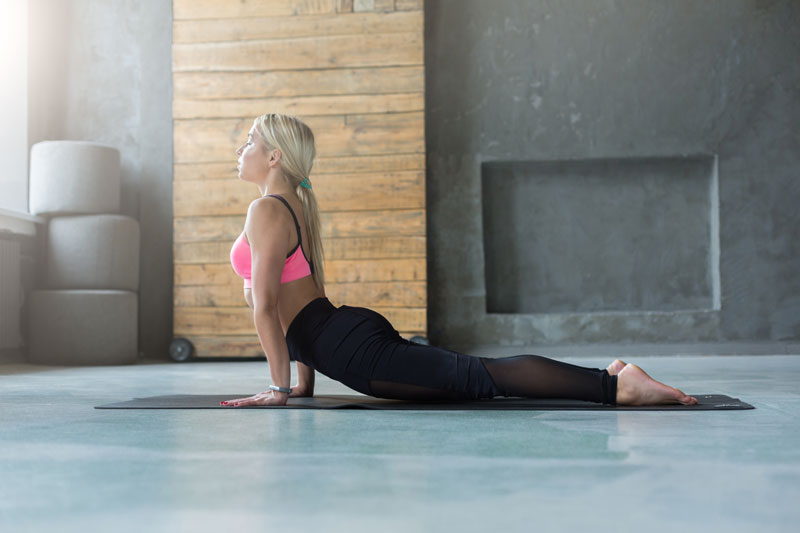
Roll on to your stomach and push up on to your forearms extending your back (as above). Go up and down 10 times. This helps with 'pushing any mild disc bulges back in to position'. The discs are vulnerable to bulges when we are lifting, doing increased sitting and our cores a
I have talked about Switching on your core the proper way in another blog and about stomach separation and appropriate abdominal exercises in 70-100% of pregnant or postnatal women have abdominal separation. Both are really important blogs to read on abdominal strengthening which is really important during and post pregnancy.
If done wrong, certain exercises can cause pain and damage to your abdomen (permanent stomach separation and hernias), back and pelvic pain. Recent research is causing controversy about which exercises help bring the stomach together and which separate it.
The take home message is that each abdomen is individual and responds differently to different exercises so it is imperative that you your stomach separation is assessed by a trained physiotherapist to tell you when your stomach has re-joined and which exercises are appropriate for you. Please ask your physiotherapist for an individual program.
Core and Butt Strengthening
Low grade core and glute strengthening exercises however, are safe to do from day one (even after a caesarean section) and a very useful platform for further strengthening once you have had your abdominal separation assessed. They are also the best exercises to do to reduce the love handles!
Clams – the gluteus medius is an extremely important pelvic stabiliser and weakness often contributes to back, hip, knee, ankle and foot problems. It has anterior and posterior fibres. Often only the anterior fibres are strengthened with the Clam exercise you may well know (lye on your side with knees bent, keep your pelvis still and hips on top of each other by switching on your core, and lift up your top knee and then slowly lower). This is an important exercise but it is actually the posterior fibres that are more important and often missed. These are strengthened with:
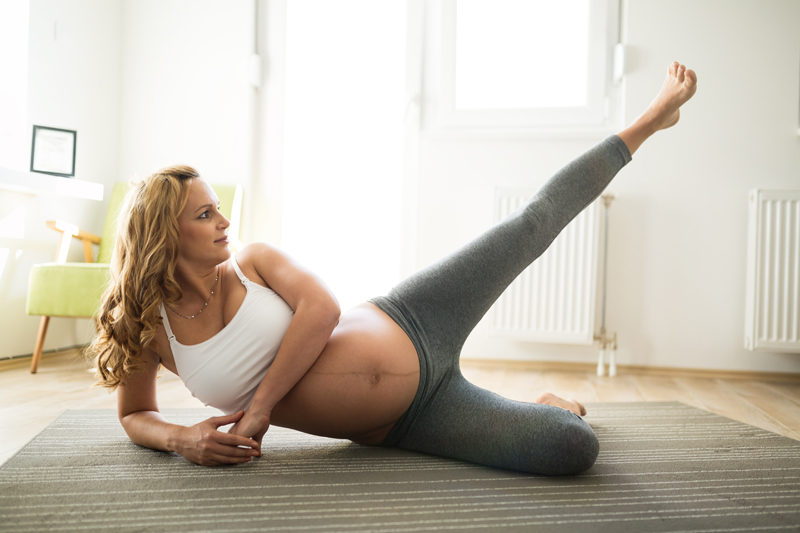
Side-lying leg lift (right) – both these exercises are incidentally excellent low grade core strengthening exercises too so make sure you activate the core to keep the pelvis and back still as you do the clam and leg lift. The other vital part of the leg lift is that you take your leg behind the line of your body to lift it up. You must keep the hips on top of each other and not twist your back backwards as you lift your leg. Your leg will want to creep forward as you get tired so pay attention that it doesn’t return to the line of your body or in front. Do 3 sets of 10 reps of each exercise on each side.
Bridges – these are often done for glut max strengthening which I do too. I do them differently as a core strengthening and spinal stretch point of view too. Instead of just lying on your back with knees bent and lifting up your bottom and lowering it, I firstly activate my core by rotating my pelvis to flatten my lower back, then activate my glut max and then my hamstrings as I lift one vertebra off the floor at a time. This prevents over activation of the erector spinae muscles which we want to relax and can stretch below. This is done very slowly and precisely and with good physiotherapy assistance you can learn how to activate the multifidus, a very important core muscle that supports the spine that is often forgotten about or not even heard of (even sadly by some physiotherapists). It is very hard to know where it is, how to activate it so needs hands on assistance of your physiotherapist to teach you and check you are doing it correctly. Without it you are not activating your core correctly which leaves your back vulnerable to injury. Lifting one vertebra up at a time not only strengthens the core, it gives a wonderful back massage, muscle stretch and mobilisation of the spine. When you get all the way up to your shoulders I then slowly lower myself one vertebra at a time until my bottom reaches the floor. It is incredibly relaxing. I love this exercise.
When your pelvis is stable (get this checked by your physiotherapist) you can progress to one legged activities and squats. With the bridge you can progress once elevated to straightening one leg in to the air so that it is in line with your raised body. This is a great glut max and medius strengthener as well as the core to stabilise you. See my blog on Baby Bonding Exercises- Mums and Bubs that you can do together when they are awake.
Back stretches
Your lower and upper back joints and muscles can get very stiff and sore from lifting and nursing your baby when your core and pelvis are not strong enough to support them. Added to that poor postures with exhaustion or, poor postures from wanting to nestle your face to theirs as you cuddle or just poor posture from years of poor habits which is SO common.
Erector spinae stretch – lye on your back and bend your knees to your chest. Hold for 30 sec- 1 min and take the opportunity to deep breath and relax
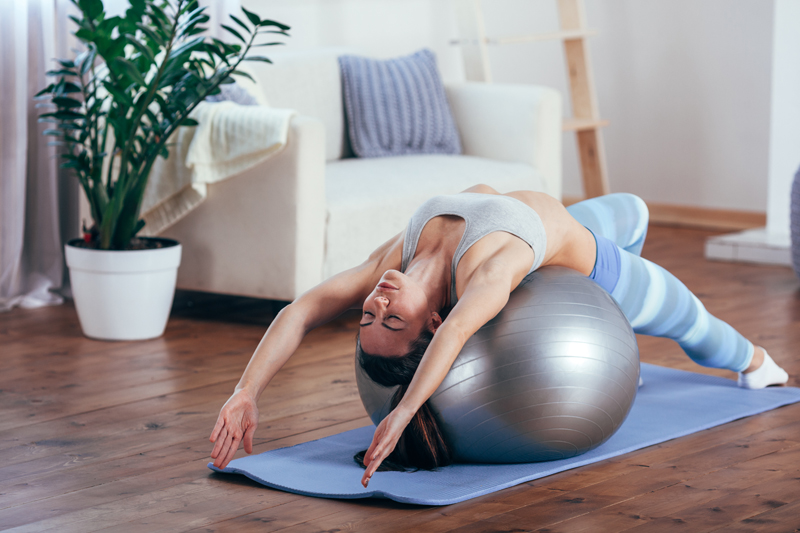
Thoracic spine and chest stretch – lye on your side holding your hands with your arms outstretched. Keep looking at your top hand while you slowly lift your top arm up and over your body until it reaches the floor on the other side. Not only does this mobilise your spine as you take your arm backwards it gives your chest (pecs) and arms (biceps) a much needed stretch from nursing. Make sure that you keep your hips on top of each other with your core on the whole time. Then return your arm back to the start keeping your eyes on your top hand. The exercise to the right is different but will give you a good thoracic and pec stretch too.
There you go; a simple, relaxing, beneficial, in so many ways, work out to do while you spend endless hours waiting for your baby to go to sleep! Genius.
See my blog on Baby bonding – Mums and Bubs for an exercise routine to do with your baby when she is awake. Again got to love the multitasking in a time where time has never been so precious.
Summary
Use this relaxing exercise routine to de-stress rather than letting your baby's non settling stress you.
Strengthening the deep abdominal and buttock muscles is very important to restabilise your back and pelvis post birth.
Remember to stretch to help with good posture, pain and relaxation.

Melli Tilbrook is a Physiotherapist based at Adelaide Physiotherapy and Pilates Studio, Beulah Park.